
Access Arizona Court Records
Arizona court records are public documents held by state and county courts. The Arizona Administrative Office of the Courts runs a statewide search system that covers most courts across Arizona. Each of the 15 counties also keeps its own court files at the Superior Court and Justice Courts. You can search Arizona court records online through free state portals, in person at any courthouse during business hours, or by mail request to the county clerk. Most records are open to the public under state law unless sealed by a judge. This includes criminal cases, civil lawsuits, family court matters, and probate records from all 15 Arizona counties.
Arizona Court Records Quick Facts
Arizona Court System Overview
The Arizona court system operates on a three-tier structure that serves nearly seven and a half million residents statewide. At the top sits the Arizona Supreme Court with seven justices who handle discretionary appeals, mandatory death penalty appeals, and administrative oversight of all Arizona courts. The Court of Appeals operates in two divisions covering different regions of the state. Division One in Phoenix has nineteen judges serving northern and central counties. Division Two in Tucson has nine judges handling southern counties. These appellate courts review decisions from trial courts and ensure consistent application of law across Arizona. Most people who search court records are looking for trial court documents from Superior Courts, Justice Courts, or Municipal Courts rather than appellate decisions. The Arizona Supreme Court also has rulemaking authority over court procedures, rules of evidence, and judicial administration. The Chief Justice serves as the administrative head of all courts in Arizona with oversight of budgets, staffing, technology systems, and operational policies that affect how courts function day to day across the state.
Each county in Arizona has a Superior Court that functions as the trial court of general jurisdiction. These are the courts that handle felony criminal cases, civil cases exceeding ten thousand dollars, family law matters including divorce and custody, probate cases, and juvenile delinquency. The Superior Court is where most major court records originate in Arizona. If you need to find a divorce decree, a felony case file, or a probate record, you will search the Superior Court for the county where the case was filed. Maricopa County operates the fourth largest trial court system in the United States with over one hundred sixty judicial officers and three thousand employees. Smaller rural counties may have only a few judges but maintain the same types of records. Superior Court judges are appointed through a merit selection process in most counties, while others use retention elections. Each Superior Court has a Clerk of Court office that maintains all case files, accepts new filings, collects fees, and issues certified copies of court documents to the public upon request.
Justice Courts and Municipal Courts handle limited jurisdiction matters at the local level. Justice Courts operate at the township or precinct level across Arizona. These courts hear civil cases up to ten thousand dollars, small claims up to thirty five hundred dollars, misdemeanors, and traffic violations that occur within their geographic boundaries. Municipal Courts exist in incorporated cities and towns across Arizona. They handle city ordinance violations, minor misdemeanors with maximum penalties of six months jail, and traffic cases within city limits. Both Justice Courts and Municipal Courts keep their own case files and records separate from Superior Court. If you get a traffic ticket in Phoenix or Tucson, that case goes to the city's Municipal Court, not the county Superior Court. Justice Court handles matters in unincorporated areas and smaller towns without their own municipal courts.
The Arizona Administrative Office of the Courts oversees this entire system. Find them at 1501 W. Washington Street, Suite 411, Phoenix, AZ 85007 or call 602-452-3300.
How to Search Court Records in Arizona
Arizona offers free online access to court case information through a statewide portal that covers one hundred fifty three of the one hundred eighty courts in the state. The main search tool is called Public Access to Court Case Information and you can find it at apps.azcourts.gov/publicaccess. This database lets you search by party name, case number, or event type to find case details from Superior Courts, Justice Courts, and many Municipal Courts across Arizona. The system shows case details, hearing dates, parties involved, and case status. Results update daily with new filings and court actions. You can search from any computer or phone without creating an account or paying fees. The Public Access system is free to use and does not require registration. Most searches take only seconds. You can look up cases from your home or office any time without having to drive to the courthouse or wait in line at the clerk's office. If you find a case you need, you can request copies of specific documents from the clerk of court in that county for the applicable copy fees.
For Superior Court documents filed after July 1, 2010, use the eAccess Portal at eaccess.azcourts.gov. This portal shows scanned court documents from civil and criminal cases filed in Arizona Superior Courts. You need to create a free account to view documents, but registration takes only a few minutes and requires just an email address and password. Once logged in, you can search by case number and view PDF copies of filings, orders, motions, and other case records. The eAccess Portal gives you access to actual document images rather than just case information summaries. This is helpful when you need to see the exact text of a court order or filing. Not all counties have uploaded their documents to eAccess yet, so availability varies by county and case type. The system works best for recent cases in larger counties like Maricopa and Pima where electronic filing has been in use for many years.
Types of Arizona Court Records
Court records in Arizona include many types of documents created during legal proceedings. Criminal records contain arrest warrants, charges, plea agreements, sentencing orders, and judgments. Civil records include complaints, answers, motions, discovery documents, trial transcripts, and final judgments. Family court records cover divorce petitions, custody orders, child support orders, parenting time schedules, and adoption files. Probate records include wills, estate inventories, creditor claims, and final distributions. Juvenile records are generally sealed from public view but may be accessed with court approval in certain situations. Each type of record serves a different purpose and is maintained by the court where the case was filed. Most records remain accessible to the public under Arizona's open records laws unless specifically sealed by court order. You can request any public court record by visiting the clerk's office in person, calling to request copies by mail, or in some cases downloading documents through online portals like eAccess.
Criminal records are used for background checks, legal research, and public safety purposes. Civil records help people check lawsuit history, verify judgments, or research property disputes. Family court records prove divorce, show custody arrangements, or document name changes after marriage or divorce. Probate records verify inheritance and estate distribution when someone dies. All of these records are created and maintained by the courts in Arizona. You can request copies from the clerk of court office in the county where the case was filed. Some records may be sealed or restricted by court order or statute. Adoption records are sealed under Arizona law. Certain mental health and substance abuse treatment records are confidential. Cases involving juveniles are generally not open to the public unless the juvenile was tried as an adult.
Court Records by County
Each county in Arizona maintains its own court records at the Clerk of Superior Court office in the county seat. Maricopa County operates the fourth largest trial court system in the United States with over one hundred sixty judicial officers serving the Phoenix metropolitan area. The Clerk of Superior Court office is located at 620 West Jackson Street in Phoenix. You can call them at 602-372-5375 for information about case files and record requests. Maricopa County offers online case search through superiorcourt.maricopa.gov/docket for Superior Court cases and justicecourts.maricopa.gov for Justice Court cases. These free search portals let you find case information without visiting the courthouse in person. The county also offers eFiling through AZTurboCourt for attorneys and self-represented litigants who want to file documents electronically rather than delivering paper copies to the clerk's office. Pima County is the second largest county in Arizona with its county seat in Tucson. The Clerk of Superior Court office is located at 110 West Congress Street in Tucson and you can reach them at 520-724-3200 during business hours Monday through Friday. Pima County provides online case search through the Agave Public Access system at agave.cosc.pima.gov/PublicDocs for Superior Court records. Justice Court cases can be searched at jp.pima.gov/CaseSearch. Both systems are free to use and updated regularly with new case information from Pima County courts. The Agave system includes some scanned documents that you can view online without having to go to the courthouse or pay for copies.
The other thirteen counties each have their own clerk offices and procedures for accessing court records. Some counties offer online search portals similar to Maricopa and Pima where you can search for free. Others require in-person visits to the courthouse or mail requests for case information. Contact the clerk of court in the county where the case was filed to find out how to access records for that specific county. Most counties charge a search fee and a per-page copy fee for court records when you request copies. Fees vary by county and court type but typically follow the standard Arizona fee schedule set by the Supreme Court. Rural counties with smaller populations may have more limited hours and fewer staff available to help with record requests, so it helps to call ahead before visiting.
Arizona Public Records Law
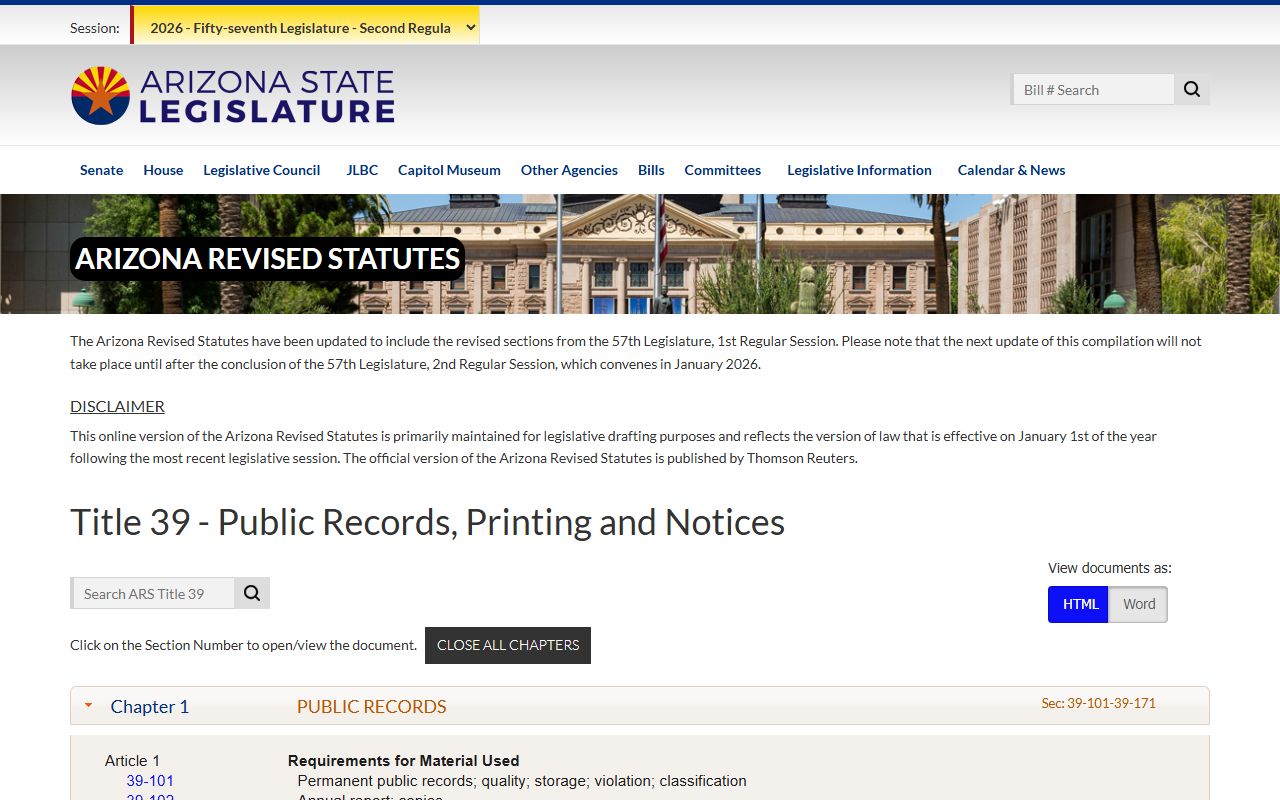
Arizona law provides broad public access to court records under the state's open records statutes. Arizona Revised Statutes Section 39-121 is the foundational public records law that establishes the right of citizens to inspect public documents. This statute says that public records shall be open to inspection by any person at all times during office hours. You can view the full text at azleg.gov under Title 39. This law applies to court records held by county clerks and the courts throughout Arizona. The presumption under Arizona law is that records are public unless a specific statute or court rule makes them confidential. Most court records fall under this public access right and can be viewed or copied by anyone who asks, regardless of whether they are a party to the case or have any particular reason for wanting the records.
Arizona Supreme Court Rule 123 governs public access to judicial records specifically. Rule 123 establishes that all court records are presumed to be open to the public. Some records are restricted by law for privacy or safety reasons. These include adoption files, mental health records, sealed cases, and certain juvenile proceedings. A judge can seal a case file if there is a strong legal reason and proper motion filed by a party. Most court records remain open to anyone who asks to see them. You do not have to be a party to a case to request court records. You do not need to give a reason for your request. The clerk may ask for your name and contact information when you make a request. They may charge fees for copies and certification. But the records themselves are public under Arizona law and must be made available unless a specific exception applies.
Filing Court Documents in Arizona
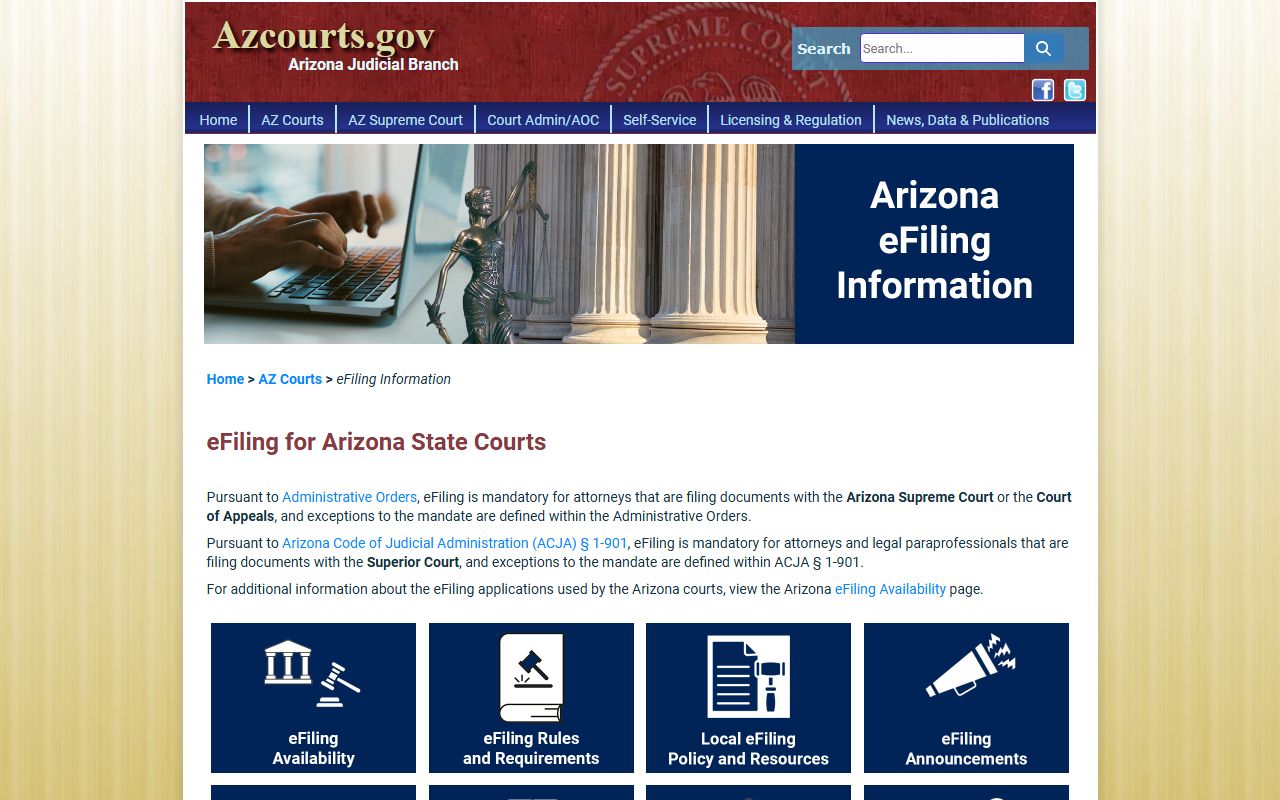
Arizona uses AZTurboCourt as its statewide eFiling platform operated by Catalis. You can learn more at azcourts.gov/efilinginformation. AZTurboCourt supports all court levels in all fifteen counties with a single registration. You create one account and can file in any court across the state. The platform accepts civil, criminal, family, probate, and other case filings electronically. This makes filing more convenient than traveling to each courthouse in person. The system is available twenty four hours a day, seven days a week except for brief maintenance windows. Documents filed electronically are stamped with the date and time of filing. The clerk's office reviews eFiled documents the next business day. Self-help resources are available at azcourthelp.org for people who represent themselves in court without a lawyer. This site has forms, guides, and instructions for common case types like family law, evictions, small claims, protective orders, and debt collection cases. You can find step-by-step help for filing a divorce, responding to a lawsuit, or starting a small claims case. The site also lists legal aid organizations across Arizona that provide free or low-cost help to people who qualify based on income. Videos and tutorials walk you through the process of filling out court forms correctly so you can avoid common mistakes that delay your case.
Court Record Fees
Fees for court records vary by county and court type in Arizona. Arizona Revised Statutes Section 12-284 sets the base fee schedule for Superior Courts and you can view the statute at azleg.gov under Title 12. Superior Court initial filings cost one hundred eighty eight dollars statewide under the base schedule. Family law filings cost one hundred forty nine dollars. Copy fees are fifty cents per page in most counties. Certification adds thirty to thirty five dollars depending on the county. These fees help fund court operations and are set by the Arizona Legislature with authority given to the Supreme Court to adjust them based on the Consumer Price Index each year. Fees collected by the courts help pay for judges, staff, courtrooms, technology systems, and other costs of running the judicial system in Arizona.
Justice Courts and Municipal Courts charge a minimum clerk fee of seventeen dollars under the standard fee schedule set by the Arizona Supreme Court. Copies cost fifty cents per page. Certification costs thirty three dollars. Marriage licenses cost eighty three dollars. These are the standard fees for limited jurisdiction courts in Arizona. Some counties may charge additional fees based on local rules or special programs like drug courts or mental health courts that have their own fee structures approved by the Supreme Court. Traffic cases may have additional surcharges that go to state funds for driver education and road safety programs beyond the base court fees.
Maricopa County raised its fees by eighteen percent on December 28, 2024 after approval from the Arizona Supreme Court. A civil complaint in Maricopa Superior Court now costs three hundred sixty seven dollars instead of the base rate of one hundred eighty eight dollars. An answer costs two hundred sixty three dollars in Maricopa. Justice Court fees in Maricopa are one hundred fourteen dollars for a civil complaint and fifty eight dollars for small claims. These higher fees only apply in Maricopa County. Other counties still use the standard state fee schedule. Check with the specific court to confirm current fees in that county before filing your case or requesting records, as fees can change when the legislature or Supreme Court approves adjustments.
Getting Help with Court Records
If you need help finding or understanding court records in Arizona, several resources can assist you. Each county has a law library open to the public where staff can help you locate statutes, case law, and court forms. The law library does not give legal advice but they can show you where to find legal information. Many law libraries have computers with access to legal research databases like Westlaw or LexisNexis and the internet. Some offer classes on legal research and court procedures for people who represent themselves. Hours and services vary by county, so call ahead before visiting your local law library. Legal aid organizations serve low income residents who cannot afford a lawyer. These groups help with family law, housing, consumer issues, public benefits, and other civil matters. They do not handle criminal cases. Contact information for legal aid groups is available at azcourthelp.org under the "Find Legal Help" section. Some counties also have self-help centers at the courthouse where staff can answer questions about court procedures and help you fill out forms. The staff cannot give legal advice or tell you what to do in your case, but they can explain how the court process works and what steps you need to take.
Arizona maintains AZPOINT at azpoint.azcourts.gov for protective orders. This system tracks Orders of Protection and Injunctions Against Harassment statewide so law enforcement can check them quickly.
Browse Arizona Court Records by County
Each county in Arizona has its own Superior Court and Clerk of Court office. Pick a county below to find local contact info and search portals for that area.
Court Records in Major Arizona Cities
Municipal courts in major cities handle city ordinance violations and traffic cases. Pick a city below to learn about local court records.